
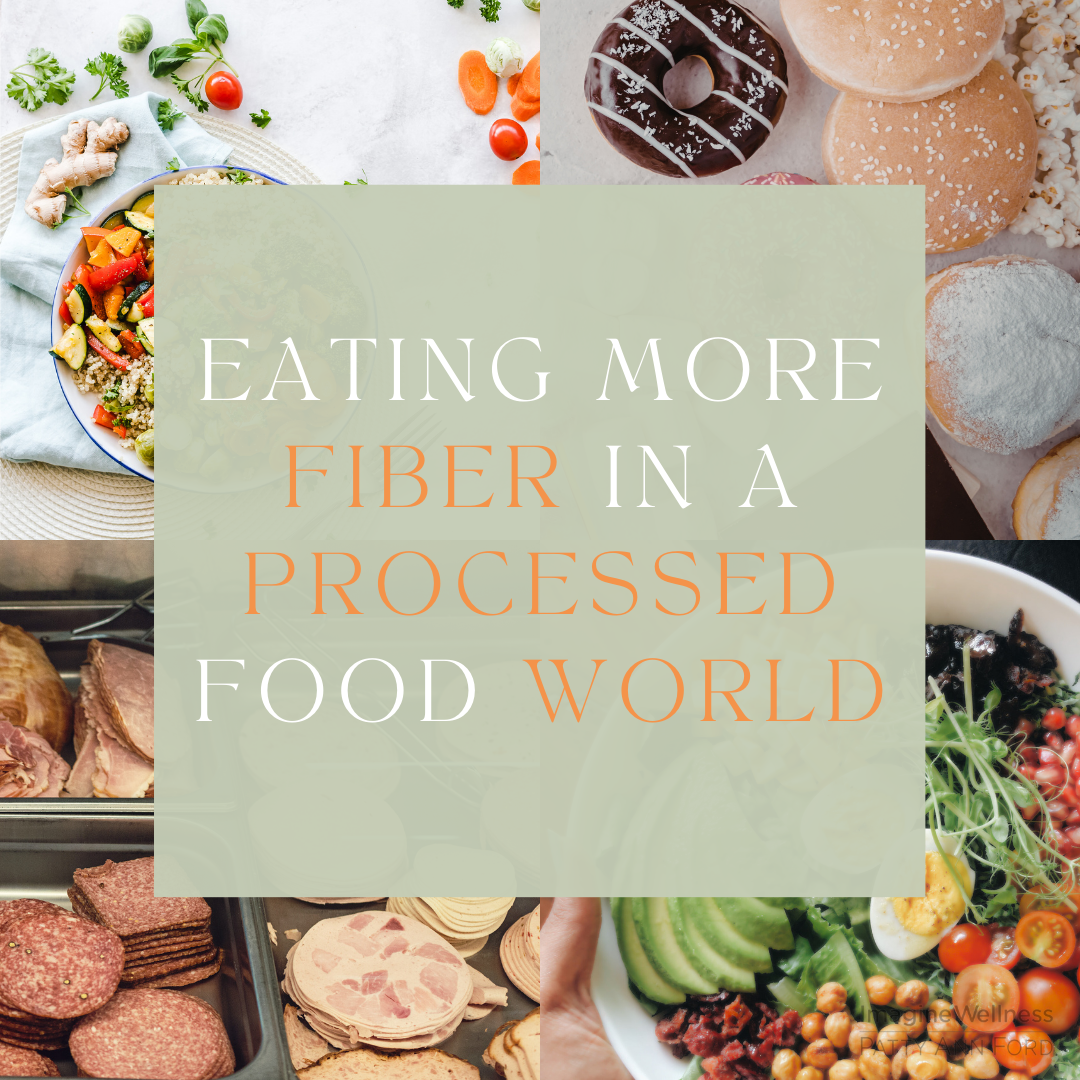
“If you’ve ever been told to “just eat more fiber” and felt quietly frustrated, you’re not alone.
Increasing fiber intake sounds simple in theory. In practice, it can feel surprisingly difficult—especially in a food environment built around convenience, speed, and highly processed options.
This isn’t a willpower issue.
It’s a systems issue. The Modern Food Environment Isn’t Designed for Fiber
Most of the foods that dominate grocery shelves, restaurants, and grab-and-go meals are designed to be:
• Shelf-stable
• Fast to eat
• Highly palatable
• Easy to digest
Fiber, by nature, doesn’t fit neatly into that model.
High-fiber foods tend to be:
• Perishable
• Slower to prepare
• Less processed
• More filling
Over time, many people unintentionally drift toward lower-fiber eating—not because they don’t care about their health, but because the environment makes it easy to do so.
⸻
Why Fiber Often Gets Left Behind
Here are a few very real reasons fiber intake can be low, even for people who are trying:
• Many common “healthy” foods are refined (white bread, white rice, low-fiber cereals)
• Meals eaten away from home are often low in vegetables, beans, and whole grains
• Busy schedules favor convenience foods over preparation
• Digestive discomfort from sudden fiber increases leads people to pull back
• Nutrition advice often emphasizes what to remove rather than what to add
None of this reflects a lack of effort. It reflects how food systems work.
⸻
Fiber Isn’t About Perfection — It’s About Exposure and Repetition
Fiber works best when it’s:
• Added gradually
• Spread across the day
• Paired with adequate fluids
• Included consistently, not occasionally
Trying to “fix” fiber intake all at once often backfires. Digestion becomes uncomfortable, meals feel forced, and the effort feels unsustainable.
A steadier approach—adding fiber meal by meal—is usually more effective and more tolerable.
⸻
What Increasing Fiber Can Look Like (Without Overhauling Everything)
Instead of aiming for an ideal number right away, it can help to ask simpler questions:
• Is there one plant food I can add to this meal?
• Can I swap in a whole-grain version occasionally?
• Can I include beans or vegetables in a way that feels familiar?
Examples:
• Adding berries or seeds to breakfast
• Including beans in soups, salads, or bowls
• Roasting vegetables to pair with dinner
• Choosing whole grains when available—not always, but regularly
These small additions matter more than dramatic changes.
⸻
Fiber and Body Trust Go Hand in Hand
Fiber supports digestion, blood sugar, cholesterol, and fullness—but it also supports something less talked about: trust.
When you nourish your body consistently, without urgency or restriction, your body becomes more predictable.
Energy steadies.
Digestion improves.
Hunger and fullness cues become clearer.
This is especially important in winter, when bodies naturally slow and appetite patterns may shift.
Fiber doesn’t rush the body.
It supports it quietly.
⸻
A Gentler Way Forward
If increasing fiber feels harder than it “should,” that doesn’t mean you’re doing something wrong.
It means you’re navigating a food environment that doesn’t naturally support it.
Progress comes from:
• Consistency, not intensity
• Addition, not restriction
• Understanding, not self-criticism
Fiber doesn’t need to be perfect to be effective.
⸻
How We Approach This at Imagine Wellness Medical Group
At Imagine Wellness Medical Group, fiber is never treated as a rule or a test of discipline.
We look at:
• What’s realistic in your life
• What your digestion can tolerate right now
• How to add fiber in ways that feel supportive, not overwhelming
• How fiber fits into medical nutrition therapy goals like blood sugar, cholesterol, digestion, and weight management
This is not about forcing change.
It’s about building health through steady, thoughtful support.
⸻
Closing Thought
In a processed food world, eating more fiber isn’t always easy.
But it is possible—one meal at a time.
Quiet nutrition still counts.
Small additions still matter.
And your body is always working, even when progress feels slow.
Recent Comments